Note: This page is automatically translated; this article was written in English, so if you are reading it in a different language and you get across strangely worded phrases or sentences that don’t make much sense, don’t blame me :))
Since too many of you seemed to have enjoyed my last article and derived some motivation from it, I sincerely hope you will take full advantage of that and find your way to the pool with a renewed excitement. To give you a little extra push I decided to waste some more of my precious time and offer you some tips on how to make the most of it.
I know a lot of people struggle with pool training, mainly mentally, and I fully understand as I did the same when I started training; I remember the struggle very well. The best word I can use to describe it is “resisting”: I was resisting it, fighting against it, hating it, not wanting to be there, and that lasted for the first few months.
I think everyone at some point go through to some form of this resistance, but I find it is a lot more common among those who start freediving in depth, and only get to the pool later on, when they realise they need additional training volume and time if they want to improve: the transition from depth to pool training is traumatising for a lot of people. The solution is stop resisting. Yes, you are right, is more easily said than done. But how can you do it in practice?
We are all different because we have different personality traits and different backgrounds when it come to sports and approach to hardship. Some people lived in cocoons their whole life and are not familiar with discomfort. Some others are constantly fighting off their demons, and discomfort is the only thing that can distract them from their struggles. Most of us are somewhere in the middle. How we respond to mental and physical discomfort depends on lot on all these factors, and therefore there won’t be 1 hack that will work for everyone. Actually there are no hacks at all, no shortcuts, no tricks, you need to learn who you are and how you function, and start from there.
But without going too deep into psychology, what can you do to become able to go through a whole pool session without panic taking over? All I can do it to tell you what did help me, which doesn’t necessarily means it will help you too, but it may give you some ideas of where to start.
DO NOT THINK AHEAD
I remember struggling a lot to even start my training session. Just reading my assignment would give me anxiety. Sometimes I went to bed already anxious about the next day’s training. So I stopped doing it: I stopped reading in advance! Only when I got to the pool, I looked at the first set and started from there, without looking at the rest, so I could be fully in the moment, as if that 1 set was the only thing I needed to do. That really helped me not to pace myself in the hope to save my energy for the rest. Only at the end of the first set I’d look at the second one. This helped my mind to stay in the moment: if you don’t know what’s coming next you can’t really worry about it.
Break a set into chunks: as we were speaking about static + dynamic sets (or dynamic + static + dynamic), you can’t lay there being all relaxed during a static if you are already thinking how much you will be suffering during the swim that comes after. You literally need to BS yourself into not knowing what come next. The way I do it is to tell myself I just need to do a static until contractions and after that I can come up if I don’t feel like it. Then I start swimming and I tell myself I can just do the first 25m. Then I’ll turn and I tell myself I can just do another 25 and so on, and then I end up not coming up until I’m hypoxic.
But this works for me because every time I think “shall I come up?” I can hear myself yelling “heck no!” not because it’s too easy, but because I can push myself through and past discomfort. But as we said earlier, some people really struggle with discomfort, so if they are given permission to give up, they will do so at the first chance. If you are someone who tend to give up early and surface without really needing it, maybe try to give yourself a minimum time/meters to cover, where there is a challenge, but a very small one. For example if you always come up at 50m wall, don’t tell yourself to do 75, but aim at doing a turn after 50. Then on the next rep, a turn and a push, then a push and 2 kicks and so on. This means that you may need more repetitions of the same exercise to allow yourself to progress with very small steps, as this feel less threatening than fewer sets with big jumps.
DO NOT look at what your buddies are doing and don’t try to copy other people approach to their own training, you do you! Comparing yourself to others never really bear any fruit, it mostly pushes you down: if someone do longer swims/holds, more repetitions, with shorter recoveries, then good for them, but dont feel bad about you needing a slower and more gentle approach. You do not need to break yourself to progress in your abilities.
DISTRACT YOURSELF WITH USEFUL THINGS
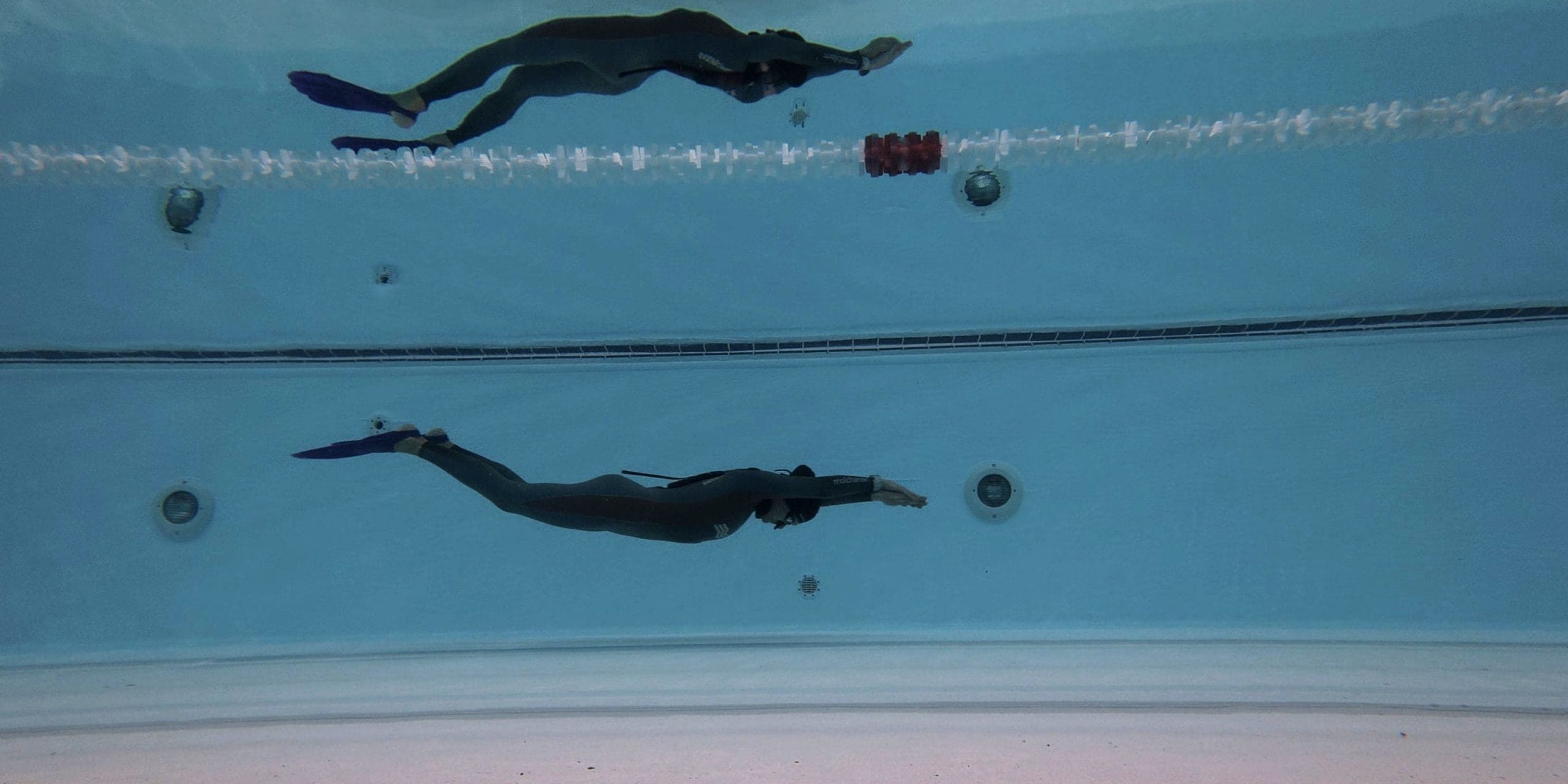
Another thing which I still do, especially when I’m feeling a bit unmotivated, is to think about technique during every single repetition. Not about technique in general, but to very specific details. For example I would spend a couple of reps just trying to make the most perfect turn I can manage, so throughout the whole 25m lap I’m visualising the moment when I see the T, the armstroke I will do with my right arm, the way I twist a bit with my body but not too much or my lobster will slide sideways, and then how I will try to bring my feet to the wall without creating too much drag and push with my heels and not the blades (because of the Velcro wall we have at our pool) and then glide after the push and not rush the first kick. And by the time I’m approaching the wall I’m literally excited about the damn turn that nothing else really exists in my mind and I often forget my assignment: was I supposed to come up at this wall or the next? Do I have a fixed recovery time? How long is the next dive? It usually takes me seconds to remember.
Then once I’m satisfied with the turn, I go to the next thing: are my arms and hands really straight in the arrow position? I straighten my shoulder and try to find the right balance between streamlining and relaxation. My hands are not always in perfect line with my arms and sometimes are pointing down, so I spend some laps moving them in different angles to find the best one.
Then when I’m done with that I pass on to something else, for example my lower back and my overall body position: I tend to arch my back and flare my ribs, so I often spend some time tucking my pelvis and readjusting over and over. Then at some point it will be my legs’ turn: I’m a knee-bender, it’s part of my physiology so I don’t look for perfection, but I also don’t want to get too lazy, so I work on finding a balance. At this point I’m usually almost disappointed to realise I’m at the end of my workout: I get so much into the details that I lose awareness of the bigger picture. Bit like living life.
There’s more stuff I can spend countless hours musing on: more practical examples?
-I tend to swim too high in the water, so I spend entire sessions trying to be close to the bottom (I hate this because it reminds me of crashing against the dive line during freefall, and the line touching my face or even worse my noseclip which automatically make me swallow my mouthfill), so I try to trick myself into staying closer by packing some and be slightly buoyant so that I have to stay deeper.
-The distance between my fins blades, do I feel them touching? Do I feel drag when they passing each other? Are they too close or too far away?
-Counting kicks for every lap and try to minimize it, not by kicking wider and stronger, but by being more efficient: smoother push off with longer glide, don’t anticipate kicks but also don’t wait until you slow down in between kicks, better streamlining, etc.
I no longer need to play these mind games to keep calm, mostly I can go through my sessions without falling into a pit of despair, but there are bad days, or some particular sets (especially involving very long dives) when this is still very useful.