Pool training for depth season
Note: This page is automatically translated; this article was written in English, so if you are reading it in a different language and you get across strangely worded phrases or sentences that don’t make much sense, don’t blame me :))
Let’s be honest, pool training is an invaluable tool for depth, for a variety of reasons.
Depth freedivers who don’t do any form of pool training will always be one step behind, and to make up for it they must impoverish themselves by travelling all the time to faraway destinations to keep their adaptation.
It is true that a pool cannot help equalisation or adaptation to pressure, but on the other hand it gives you a lot more than depth training.
How? Well, let me waste the rest of my afternoon to ramble about it.
Consistency of training
For 99% of freedivers it is a lot easier to find a pool close to home than having regular access to depth. That means you can build a routine, have a program to follow, and as you may have heard hundreds of coaches saying, consistency is the number one factor in growing as a freediver.
I live 10 meters away from my depth training spot, and yet I rely a lot more on pool training…why?
I don’t like to push myself in depth, and if I do I tend to bring that unpleasant feeling over to my deep dives. I much prefer to build my adaptation in the pool and look at my depth sessions as a reward and something nice and happy. Ever heard the concept of train hard, race/fight/dive easy? That is a well-known concept in sports.
Conditions are unstable, some days a session get cancelled because it’s cold, or there’s current, or waves, or wind (or everything at the same time), or I don’t have a buddy I trust, etc. And if I push myself to go diving on the miserable days, I get mental burnout and I’m cooked for a while. On the other hand, it’s rare that I have to cancel a pool training. Pools are reliable and always welcoming:))
Mental training
In the pool you can do combination of exercises that you can’t do in the sea. Why we tend to vary pool training so much and design programs with these complex combinations is to avoid boredom, burnout, and expectation. When your sessions vary you stop comparing your results between sessions and that’s a great way to focus on effort and not on numbers. Doing specific exercises such as a static in the middle or at the end of a dynamic dive, or a fast dive followed by a slow one after a very short recovery, will train your mind to accept discomfort and stay calm. Often you will realise that you expected these sets to be a lot harder than they felt, and that gives you a big boost in self-confidence and excitement. It is hard to recreate this in depth. And since most people have a limited access to depth, when they do, all they want is to go for a PB dive every day, which is as understandable as it is counterproductive. I always tell my students that “A deep dive is not training, but the result of the training you did so far,” so deep dives should be the culmination of a training cycle, not “the” training cycle.
Physiological training & Dive reflex
You can do a huge amount of repetitions in a single pool session compared to depth, which is especially important for CO2 tolerance, as you will do several dives with short recoveries.
When you dive in the sea you often have 10+ minutes breaks between dives, even if you try to be efficient; and when you’re diving with 1-2 buddies it’s almost impossible to do tables because you can’t take over the line for a whole half hour and expect your buddies to scratch their bellies while waiting.
The pool is also a much safer environment to push dives when you want to work on your O2 tolerance.
Yes, I do agree that the benefit of depth training cannot be replaced completely, especially when it comes to equalisation and depth adaptation. You can do dry equalisation training, and you can also do a bunch of FRC training at the pool and your daily dry stretches: but eventually you do need to put your body at depth, to finalize your preparation. But keep in mind that a lot of equalisation and pressure problems are created by poor relaxation, and that relaxation increases dramatically when you have a monster breath hold and when your legs get no longer lactic: trust me when I say that the mental boost you get from the pool won’t go unnoticed.
Now that we got the WHY out of the why, let’s talk about the HOW
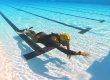
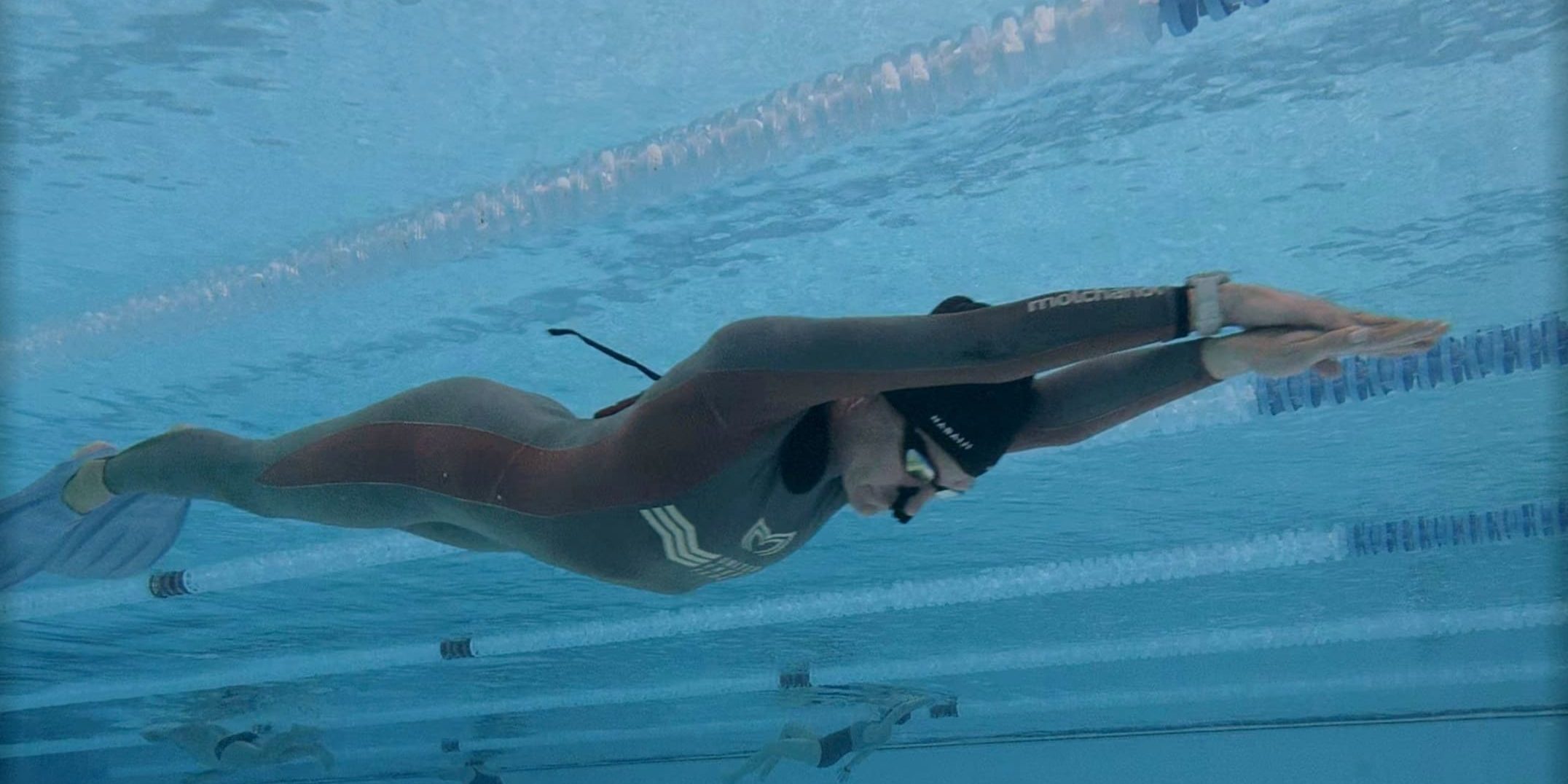
How to specific training for depth in the pool: Even though most pool training (especially dynamic) works great for depth too, there are a few tweaks you can do to make it more relevant for depth. Breaking a dive in half is a good way to do that: deep dives have 3 specific phases that dynamic dives don’t have. But in the pool we can recreate these phases by pretending we are doing a descent (a slow relaxed 25-50 meters dynamic), a freefall (static on the bottom of the pool) and an ascent (a faster dynamic that is at least equal or preferably longer than the first section).
How to organize this exercise practically:
-Be slightly overweighted or you will float up when it’s time to do the bottom static.
-Depending on your abilities and your diving style, you will do either a 25 or 50 dynamic. If you are a slow freediver who likes to go down slow and favour relaxation over speed, you can start with a slow 25m. If you like to go faster and start to freefall very late then go with a faster 50m.
-When you get at the wall stop and relax. You can decide to do a short static and go by your watch (let’s say, start with 10″ then 20, 30 etc), or personally I never look at my watch and I always wait for the urge to breathe. This is a crucial part and many people want to freak out or come up at this point, so my suggestion is that you start very easy and then add a degree of effort only if the previous dive was enjoyable (in the fucked up sort of way that only freedivers like).
At this point you will start swimming again, this time faster because at depth you need to find negative buoyancy, and keep speeding up slightly. Personally I speed up a lot because it makes me forget about contractions and doesn’t make my legs any more tired than if I went slow, but I can cover a lot longer distance; but I’m a slow down/fast up diver and not everyone is the same, so you need to find your own pace.
If the first leg was 25, then try to do 50m, but again you may want to start easy and do 25 on the first dive. Sometimes if I start with 50m I only do a short static without the third leg as a warm up.
So to summarise, as an example (but you can customize this any way you like, including adding or reducing repetitions)
25m dyn + 10″ static + 25m dyn
25m dyn + 20″ static + 40m dyn
25m dyn + 30″ static + 50m dyn
25m dyn + 40″ static + 50m dyn
25m dyn + 40″ static + 60m dyn
25m dyn + 40″ static + 75m dyn
Always take note of your total time!
For your reference, my last couple of sessions looked like this:
25m dyn + 20″ static + 50m dyn (total divetime 2:28)
25m dyn + 49″ static + 75m dyn (total divetime 3:08)
50m dyn + 1:02″ static (total divetime 2:19)
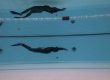
50m dyn + 50″ static + 25m dyn (total divetime 2:24) *video of this dive below
50m dyn + 45″ static + 50m dyn (total divetime 2:37)
25m dyn + 20″ static + 25m dyn (total divetime 2:09)
25m dyn + 51″ static + 50m dyn (total divetime 2:41)
25m dyn + 43″ static + 50m dyn (total divetime 2:27)
25m dyn + 52″ static + 75m dyn (total divetime 2:49)
25m dyn + 49″ static + 100m dyn (total divetime 3:16)
Keep in mind that the longer the first leg the harder the exercise will be even if the total distance is the same, i.e. 25m + 75m is easier than 50m + 50m.
If I compared these with the “stop and go” (static + dynamic) they are significantly shorter in terms of time, in fact I can do 4:30″ dives if I start with just a static followed by 100 m dynamic, because I get much later contractions: but these kinds of dives are less comparable to deep dives because they miss the whole “descent” phase.
However, since varying workouts is a must, it is good to do a bit of everything instead of getting stuck with 1 exercise and repeating it over and over again, constantly try to beat yourself: you will end up burning out and lose motivation and your love for training.
Since I mentioned lactic training above, if you want to work on improving that aspect of your deep dives, then a very efficient way to do this is sprinting!
Examples:
6 x 25m sprints on a small inhale, with just a few breaths between each 25 (5-10-15-20 fast breaths, depending on your level of ability/fitness). Do 2 set of this at the end of a session and try not to die!
Or try this:
1-2 x 50m frc dyn + 5-20″ rest + 4 x 25m frc sprints (with 5-10-15-20 fast breaths between, depending on your level of ability/fitness). Do 2 sets but have safety watching you. This is literally a leg breaker.
Happy training!